How does MANKAIND keep requirements, design, risk and tests consistent?+
Requirements, design decisions, risk controls and verification evidence live as linked records in one workspace. Each link shows where a decision came from, what depends on it and what verifies it. Your team creates and reviews those links as the engineering progresses, and AI can review linked records and point out gaps for your experts to resolve. Every revision and review stays on the record.
What happens when a requirement or component changes?+
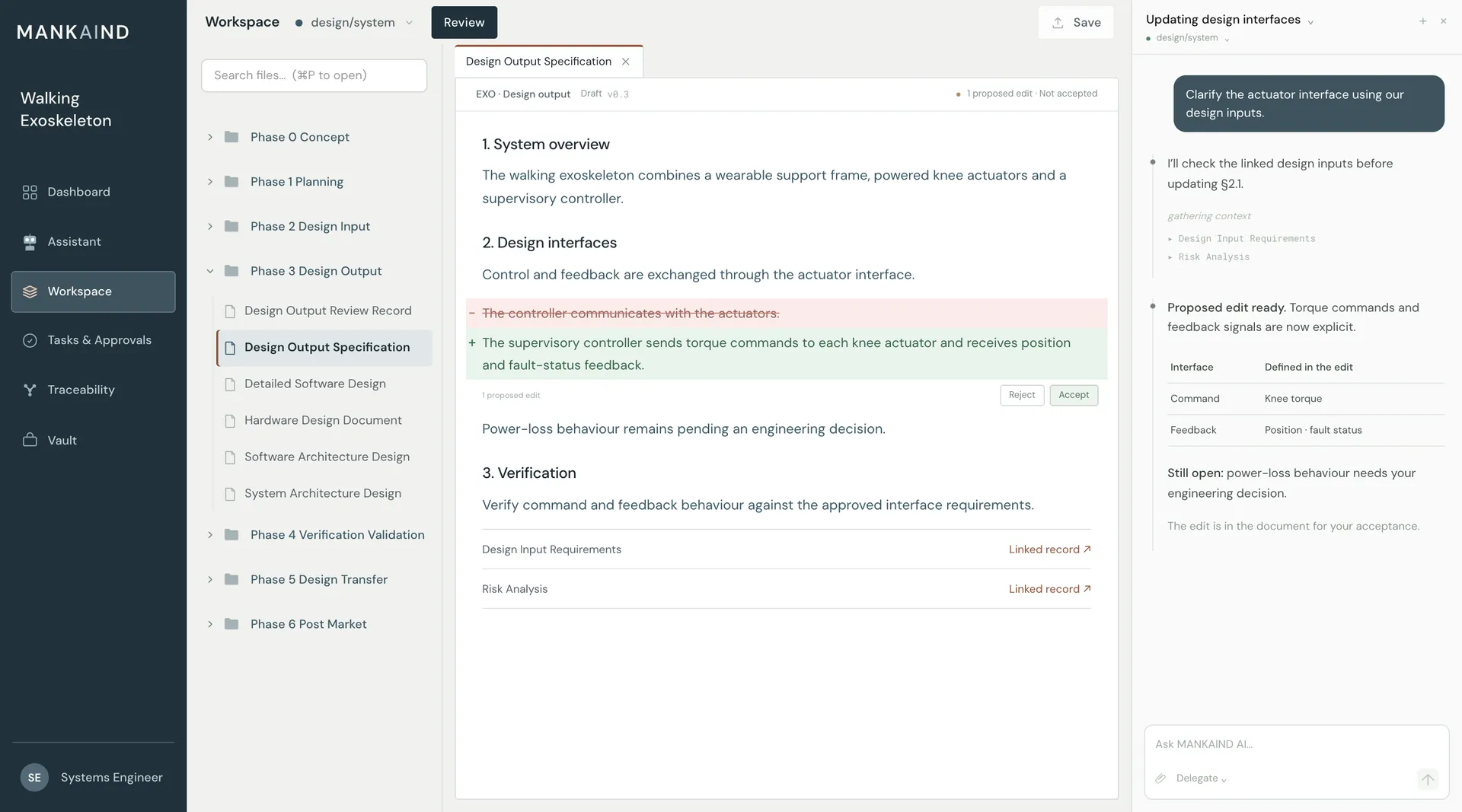
MANKAIND follows the links from the change to the requirements, risk controls and verification results connected to it, so your team sees the consequences before accepting the change. AI can prepare the impact assessment: proposed updates to linked records, tests that may need repeating and questions that need an engineering decision. Your experts review each proposal and approve what is accepted. The knee-actuator example above shows one such change.
What does the built-in PLM manage?+
The built-in product lifecycle management (PLM) manages engineering files in their native formats, such as CAD models, drawings and technical specifications, together with requirements, design decisions, risk analyses and verification evidence. Each record keeps its revisions, review history and links to related records. Ask us how part numbers, bills of materials, variants and configurations are handled for your programme.
Can we keep using our existing engineering tools?+
Yes. Keep designing in SolidWorks, Altium Designer or ANSYS. MANKAIND manages the resulting files alongside the requirements, risks and verification evidence they affect. File management is separate from live integration: automatic synchronisation depends on the connections available for each tool. Ask us which connections suit your toolchain, including requirements and issue-tracking tools, and any PLM you keep during the transition.
What if the AI gets something wrong?+
MANKAIND AI grounds its work in your programme records and reference material such as regulations, standards and engineering literature, and presents its proposals with the supporting references. It can still misread a source or reach a wrong conclusion. Every proposal therefore stays a draft until your experts check the references, decide what to accept and approve the record through your quality procedures. A demo can show how AI proposals and human approvals appear in the record.
How do we validate MANKAIND for regulated use?+
MANKAIND tests and maintains the service. The validation evidence, release information and assurance support we supply are specified in your customer agreement. Your organisation establishes the intended use, the validation of your own configuration, any tool classification or qualification your standards require, and the electronic-record and signature requirements that apply. Our testing supports that work without replacing it, and an approval record alone does not demonstrate every electronic-record or signature requirement. Your quality team can review this with us before a purchase.
Where is our data hosted, and who processes it?+
MANKAIND hosts programme records in the EU and US. Before onboarding, we confirm the hosting location, AI processing providers and other subprocessors for your programme under a data processing agreement, including any export-control or customer data-residency requirements you have. Records are encrypted in storage and transit, access is role-based, our LLM providers apply zero retention and your engineering data is excluded from model training. Our SOC 2 programme is in progress, and security documentation is available on request.
Can MANKAIND replace our existing PLM and eQMS?+
MANKAIND is designed to serve as both: product lifecycle management and an electronic quality management system (eQMS) covering product development and company-wide quality processes. During onboarding we map your existing records, procedures, roles and approval workflows, including programmes already in progress. Using MANKAIND does not by itself establish regulatory compliance or certification; that comes from your organisation’s processes and assessments, which draw on the connected records MANKAIND holds.
How is MANKAIND priced?+
Pricing is per programme, based on your team, required features and development needs. We review those needs and the onboarding scope with you, then provide a quote that defines the programme covered and the included scope before you commit.
Can we export our programme records if we leave?+
Your engineering content belongs to you. Before contracting, we confirm which records can be exported, in which formats, and how revisions, approval history and links between records are handled. We also specify retrieval time and deletion arrangements, including backups, so your engineering and QA teams can assess whether the export meets their needs.